Lexus has brought the eighth-gen ES to India, and the hybrid ES 350h starts at ₹66.10 lakh (ex-showroom). It's a self-charging hybrid, so you never plug it in. But here's the catch: it costs ₹16–19 lakh more than an Audi A4 or Toyota Camry. So does the fuel saving really pay for that gap? Let's do the math.
Price and variants: what the ₹5.7 lakh trim jump buys
The Lexus ES 350h comes in two trims. The base Exquisite is ₹66.10 lakh (ex-showroom). The top Luxury is ₹71.80 lakh (ex-showroom). That's a ₹5.70 lakh walk-up between them. On-road prices will be higher once you add road tax, registration and insurance, and these vary by state. The main extra you get on the Luxury trim is the Drive Monitor (a camera that watches the driver for signs of drowsiness). Both trims share the same engine, screen, safety kit and warranty. So the Exquisite is the smarter buy for most people.
Lexus ES 350h — Price by variant
| Variant | Ex-showroom price |
|---|---|
| Exquisite | ₹66.1 lakh |
| Luxury | ₹71.8 lakh |
How the hybrid works: self-charging, no plug, 25.22 kmpl
This is a strong self-charging hybrid. You never plug it in. The car mixes a 2.5-litre four-cylinder petrol engine with an electric motor and a small lithium-ion battery (the pack that stores power). The petrol engine makes about 186–189 bhp and 237 Nm of torque (pulling power). The electric motor adds around 159–162 bhp. In city traffic the e-motor does a lot of the low-speed work, so the petrol engine rests. The battery recharges itself using braking energy, so there's no charging hassle. ARAI (a government test, always higher than real driving) rates it at 25.22 kmpl. That's very high for a luxury sedan. In real city use expect roughly 16–19 kmpl, still much better than a pure-petrol rival.
Real fuel cost vs rivals: does the saving pay off?
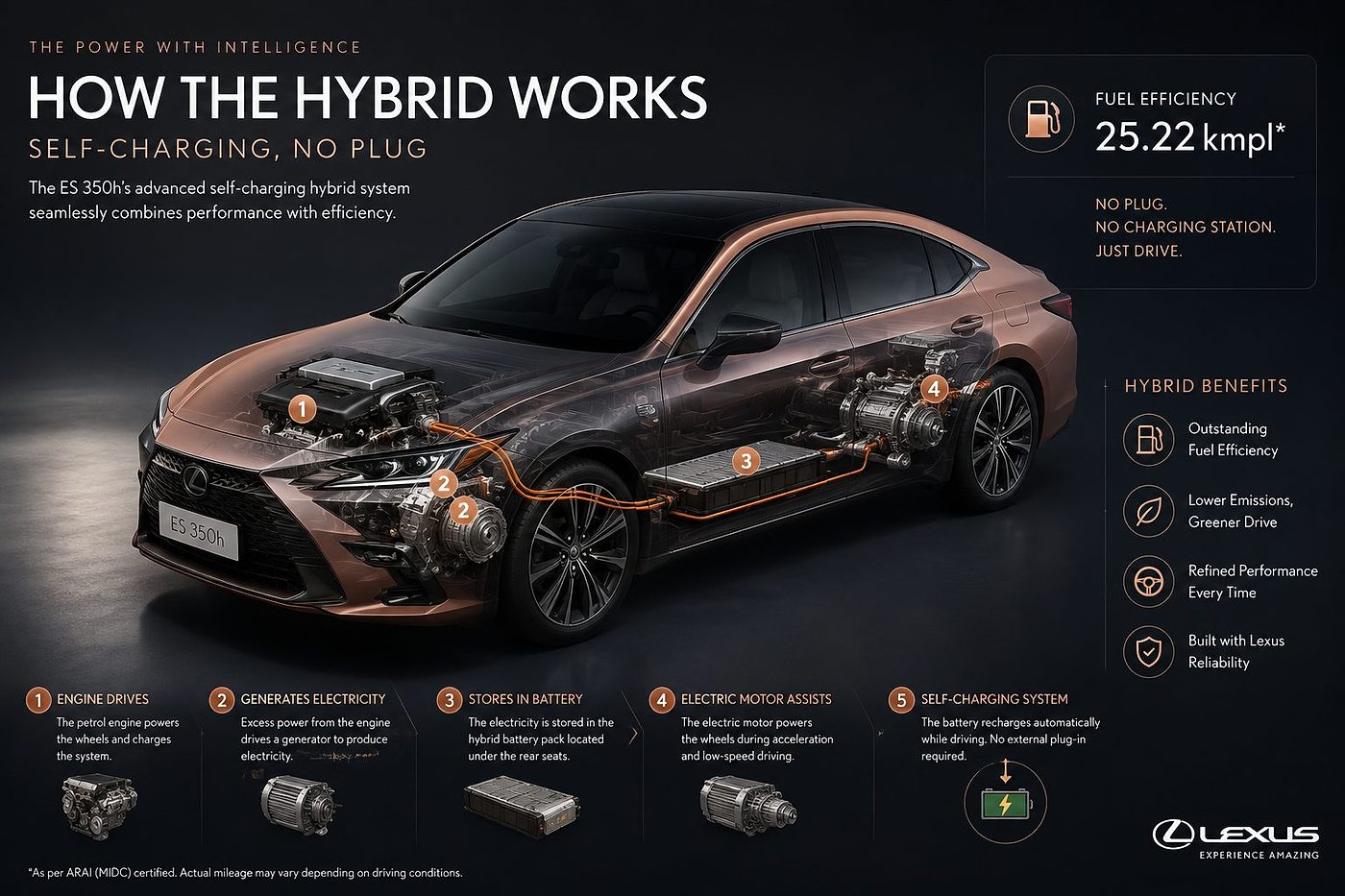
Here's the honest math. At ₹100 per litre and 25 kmpl (claim), the ES costs about ₹4 per km on fuel. An Audi A4 or Camry runs pure petrol and returns roughly 10–12 kmpl in the city, so about ₹8.5–10 per km. Say you drive 15,000 km a year. The ES saves you roughly ₹70,000–80,000 a year on fuel. Sounds good. But the ES 350h costs ₹16–19 lakh more upfront. At that saving rate, the payback takes over 20 years. So fuel savings alone don't cover the price gap. You're really paying for the Lexus badge, the refinement and the peace of mind.
What ₹66 lakh gets you: features and safety
The cabin gets a big 14-inch touchscreen with the new Lexus Interface and a fully digital driver display. Lexus adds 'Responsive Hidden Switches', physical buttons hidden in the trim that show up when you touch them. On safety, both trims get eight airbags, ISOFIX child-seat mounts, and the Lexus Safety System+ ADAS suite (safety tech that can brake and steer for you). This includes automatic emergency braking, adaptive cruise control, lane-keeping and blind-spot alert. The car is bigger than before at 5,145 mm long with a 2,950 mm wheelbase, so rear-seat space and comfort improve. The Lexus Connected app lets you check fuel, start the engine, lock doors and set the AC from your phone. Handy, though most rivals now offer similar app features.
Lexus ES 350h vs Audi A4 and Toyota Camry: the price gap
This is where it gets tough for Lexus. The Audi A4 costs ₹46.88–55.83 lakh. So the ES 350h base is ₹19.22 lakh dearer than the A4 base, and still ₹10.27 lakh more than the top A4. The Toyota Camry (₹48.69–48.89 lakh) is about ₹17.4 lakh cheaper than the Lexus base. Even the BMW 2 Series Gran Coupe starts at just ₹45.80 lakh. What Lexus offers that they don't: a true self-charging hybrid in this class, plus an 8-year/2,00,000 km warranty covering both car and battery, and a guaranteed buy-back of up to 65%. The Germans have the sharper brand image and a wider petrol range. Lexus is selling calm, low fuel bills and Japanese reliability instead.
Who should buy the ES 350h, and who should skip it
Buy the ES 350h if you're chauffeur-driven, clock 15,000-plus km a year mostly in city traffic, and want a quiet, no-plug hybrid with a long warranty. The refinement and low running costs suit business owners who value calm over flash. Skip it if the ₹16–19 lakh gap over a German sedan matters more to you than fuel savings, because the payback on fuel alone runs into decades. If you want status and a badge people know, the Audi or BMW does that for less. If you want frugal luxury and don't care about plugging in, the ES fits the bill. The Exquisite at ₹66.10 lakh is the pick; the Luxury's extras don't justify ₹5.7 lakh more.
References: Lexus India — official website