Toyota just sold nearly half of every hybrid car in India this year. The Innova Hycross led the pack with 27,812 units in the first six months of 2026. But here's the twist: its sales actually fell 6% from last year, even as the whole hybrid market grew 23%. So if you're eyeing the ₹26.76 lakh hybrid VX, the real question is whether waiting periods are easing and if rivals are catching up.
Innova Hycross sales H1 2026: 27,812 units, 48% share, but down 6%
The Toyota Innova Hycross stayed India's top-selling strong hybrid in the first half of 2026. It sold 27,812 units, giving it a big 48% slice of the market. That's almost one in every two hybrids sold in the country. But the number tells only half the story. Its year-on-year sales dropped 6%, even while the strong hybrid segment as a whole jumped 23%. So it's still No.1 by a mile, just not growing like it used to.
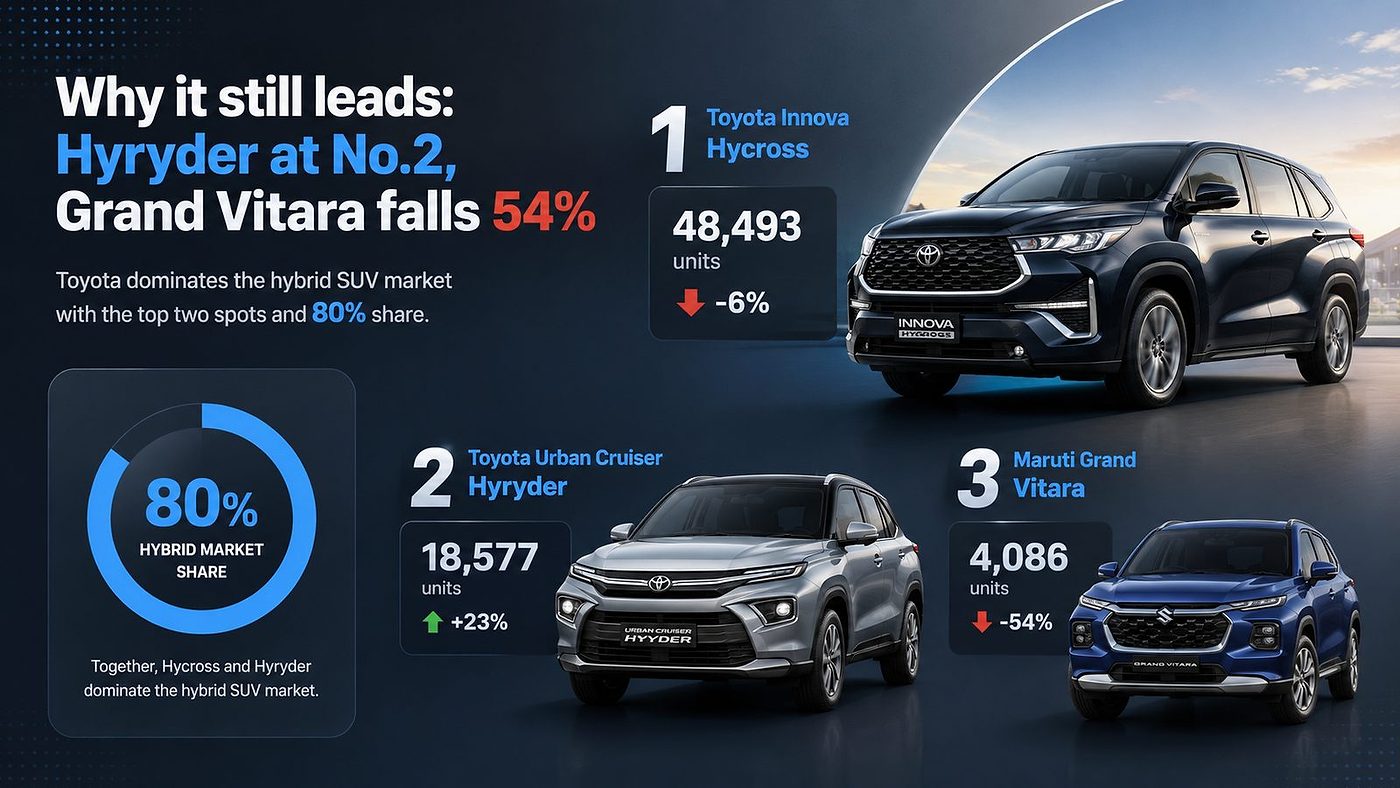
Why it still leads: Hyryder at No.2, Grand Vitara falls 54%
The gap to No.2 is huge. Toyota's own Urban Cruiser Hyryder took second with 18,577 units and a 32% share, and it grew a healthy 23%. Then there's a steep drop. The third-placed Maruti Grand Vitara managed just 4,086 units, a full 14,491 behind the Hyryder, and its sales crashed 54%. In short, Toyota holds the top two spots and owns 80% of the hybrid market between them. The Hycross rules, but momentum inside the brand is shifting toward the smaller Hyryder SUV.
Price and mileage: ₹26.76L hybrid vs ₹19.53L petrol, and the payback
The Innova Hycross starts at ₹19.53 lakh for the GX petrol (ex-showroom). That version gives 170 bhp and an ARAI figure of 16.13 kmpl (a government test, always higher than real driving). In city traffic, expect closer to 11–12 kmpl. The strong hybrid begins at ₹26.76 lakh for the VX, jumps to 186 bhp, and claims 23.24 kmpl ARAI. Real-world you'll likely see 17–18 kmpl in the city and around 15 kmpl on the highway. That's a big jump for daily use. The catch: the hybrid costs roughly ₹7 lakh more than the base petrol. On fuel savings alone, payback takes years, so the hybrid makes sense mainly for high-mileage users.
Strong hybrid explained: no plug, and a UP tax waiver worth ₹1.8L+
The Hycross uses a strong (self-charging) hybrid. That means no plug and no charging stress. A petrol engine and an electric motor work together, the motor drives the car at low city speeds, and braking recharges the small battery. This is very different from Maruti's mild hybrid, which can't run on electricity alone. The bigger money angle is road tax. Uttar Pradesh gives a 100% road-tax waiver on strong hybrids, which can save ₹1.8 lakh or more on a car this size. That waiver alone can make the hybrid premium worth it. Delhi has a draft plan for 50% off on strong hybrids under ₹30 lakh, but check your RTO, as rules vary by state.
Innova Hycross vs Maruti Invicto: same tech, ₹1.79L gap, 19× the sales
The Maruti Invicto is basically a rebadged Innova Hycross. Same hybrid setup, same platform, and it starts at ₹24.97 lakh, a full ₹1.79 lakh cheaper than the Hycross VX. On paper, the Invicto is the smarter buy. But buyers didn't agree. Toyota sold 27,812 Hycross units against just 1,418 Invictos, nearly 20 times more. The badge and Toyota's service reputation clearly matter more than a ₹1.79 lakh saving here. If resale and brand pull top your list, the Toyota wins. If you only care about the sticker price, the Invicto quietly undercuts it.
Should you buy now, or wait?
The 6% dip has an upside for you: softer demand usually means shorter waiting periods than the crazy waits of a couple of years ago. Strong hybrids also hold resale better than EVs, roughly 15–20% stronger on the used market. If you drive 15,000 km a year and live in a state like UP with the tax waiver, the VX hybrid at ₹26.76 lakh is the sweet spot. But if you barely cross 8,000 km a year, the ₹19.53 lakh GX petrol saves you upfront money that fuel savings won't recover. The one worry: Toyota's own Hyryder is growing fast, so future updates may favour the smaller SUV. For now, the Hycross still makes the most sense for a large family that wants a genuine three-row MPV with real fuel savings.
References: Toyota India — official website