₹15.25 lakh for an electric SUV sounds like a printing error. Then you read the small print. Toyota keeps the battery, and you pay ₹4.99 for every kilometer you drive under its new Battery-as-a-Service (BaaS) plan. It's India's first big battery-lease play from a mainstream brand, and whether it saves you money depends entirely on how much you drive.
BaaS explained: ₹15.25 lakh upfront + ₹4.99/km. Who wins?
BaaS means you buy the car but rent the battery. So instead of paying ₹23.60 lakh for the E3 with battery ownership, you pay ₹15.25 lakh (ex-showroom) upfront and lease the pack. Every kilometer you drive costs ₹4.99 as a subscription charge. The idea is simple: lower the entry price so more people can afford an EV. The catch is that heavy drivers keep paying, month after month. The saved ₹8.35 lakh upfront only stays saved if you don't rack up big yearly running.
Toyota Urban Cruiser eBella price: Ownership vs. lease
Right now only the top E3 trim is live in both forms. The E3 with battery ownership is ₹23.60 lakh (ex-showroom). The same E3 under BaaS is ₹15.25 lakh (ex-showroom), plus the ₹4.99/km lease. Toyota says the lower E1 and E2 variants will get BaaS pricing in the coming months, so those numbers aren't out yet. Remember, an ex-showroom excludes on-road costs (road tax, registration, and insurance), which vary by state, and it doesn't include a home charger or its installation.
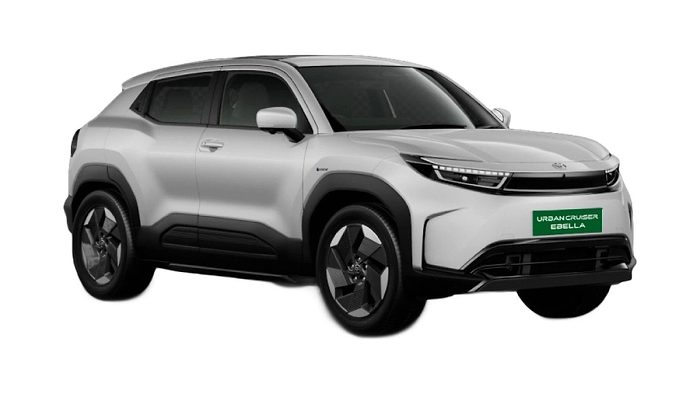
Toyota Urban Cruiser Ebella
SUVBattery, range, and charging: 49 kWh vs. 61 kWh
The eBella comes with two battery packs. The 49 kWh pack claims up to 440 km, and the 61 kWh pack claims up to 543 km. These are claimed figures, so treat them as the ceiling. In real driving, expect roughly 300–380 km from the big pack, less in city crawl with AC on, more on a steady highway run. A 10–80% top-up on DC fast charging takes about 45 minutes, enough for a coffee break on the Mumbai–Pune Expressway. Toyota also backs the car with over 500 EV-ready service touchpoints across India.
Power and features: 172 bhp, Level 2 ADAS
The single motor makes 172 bhp and drives through a single-speed automatic, so there's no gear shifting. That's a healthy pull for quick city overtakes and easy highway cruising. The E3 packs a 10.1-inch touchscreen and Level 2 ADAS (safety tech that can brake and steer-assist for you). Since only E3 is fully launched, the E1 and E2 feature lists will come with their BaaS pricing later. So today, the loaded top trim is what you're actually buying.
eBella vs. Rivals: Where the ₹/km Trap Bites
At ₹15.25 lakh BaaS, the eBella looks cheaper than the MG ZS EV (₹15.50–18.14 lakh) and the Tata Curvv EV (₹16.99–19.49 lakh). But the lease flips the math. Drive 15,000 km a year, and the ₹4.99/km adds about ₹74,850 every year. Over three years, that's roughly ₹2.25 lakh on top. The Mahindra XUV400 (₹15.49–17.69 lakh) and VinFast VF 6 (₹17.29–19.19 lakh) sell the battery outright, so your running cost is just electricity, around ₹1–1.5 per km at home. That's the real trap: the low sticker hides a per-km bill that ownership rivals don't have.
Who should buy (or wait)
BaaS makes sense if you drive light, under 10,000 km a year, mostly in the city. It also suits corporate fleets that want a low upfront outlay. If you drive a lot, the ₹4.99/km piles up fast, and buying the battery outright at ₹23.60 lakh works out cheaper over time. But at that price you're paying well above the Curvv EV and ZS EV, so you're really paying for the Toyota badge, the wide service network and the 60% assured buyback after three years. If you want the cheaper E1 or E2, it's worth waiting for their BaaS pricing before you decide.
References: Toyota India — official website