Tata already sells the five-seat Harrier EV. The Safari EV is its longer, three-row twin, and it's expected to be the only electric SUV under ₹30 lakh with a real third row. Everything else—the battery, the motor, the range—is shared. So the big question for you is simple: do you actually need those extra two seats?
Safari EV launch date: late 2026 or early 2027?
Tata has not announced an official launch date. Our own timeline points to late 2026 or early 2027. Some earlier reports linked it to the 2026 festive season, though that window has now passed. Test cars have been seen testing in heavy camouflage, which tells us the car is real and close, not that it's ready. Treat the timing as "expected," and don't rush a booking on a date Tata itself hasn't given.
Safari EV price in India: how much over the Harrier EV?
We expect the Tata Safari EV to cost around ₹22.5–30 lakh ex-showroom. The Harrier EV starts under ₹20 lakh. So you're looking at a premium of about ₹2.5 lakh or more at the entry point. That gap is the price of the third row and a bigger body, since the mechanicals are the same. Remember, ex-showroom is just the start. On-road price adds road tax, registration, and insurance, which varies by state, and it excludes the home charger and its installation.
Safari EV battery, range, and charging: why less than the Harrier EV?
Tata has not confirmed the battery, the range, or the charging speed. Our reference point is the Harrier EV, which uses 65 kWh and 75 kWh packs (kWh is the battery size) rated at 538 km and 627 km on the ARAI test (a government test that always reads higher than real driving), with some reports suggesting a larger 80 kWh pack for the Safari EV. The Safari EV is heavier and taller, so its range should be slightly lower. We expect a real-world figure of roughly 500–600 km on the top version, so plan for about 70% of any ARAI claim in daily use. On DC fast charging, expect a 10–80% top-up in around 25–30 minutes, and a home AC wallbox will take several hours overnight. Running cost at home works out to about ₹1–1.5 per km, versus ₹6–9 per km on petrol, so it's roughly 5–7 times cheaper to run.
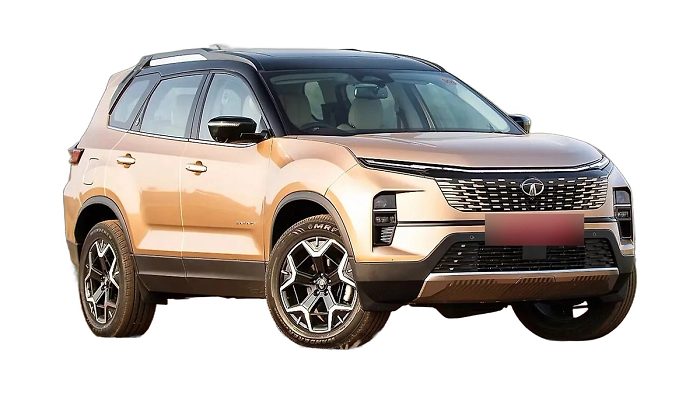
Tata Safari EV
SUVSafari EV interior and features: triple-screen dash and 6/7 seats
The Safari EV is expected to move to a triple-screen dashboard (a third screen for the front passenger), like the Sierra. The current petrol/diesel Safari uses a dual-screen setup, so this would be a step up. Both six-seat (captain chairs in the middle) and seven-seat layouts are expected, so you can pick space or one extra seat. Expected features (based on Harrier EV and segment norms) include a panoramic sunroof, ventilated front seats, wireless Apple CarPlay and Android Auto, and a powered tailgate. On safety, advanced safety tech is expected, though Tata has not detailed the suite. Just note: none of this is confirmed by variant yet, and the top kit usually lands on the pricier trims.
Safari EV vs Harrier EV: the ₹2.5 lakh question
This is the real fight, and it's an in-house one. The Harrier EV is on sale now, from under ₹20 lakh, and it does everything the Safari EV does, minus the third row. Same acti.ev platform, same batteries, same motors, similar range. So your extra ₹2.5 lakh (and an 18-month wait) buys the third row and the triple-screen dash, little else. Against outside rivals, there's no direct match: the Mahindra XUV400 (₹15.49–17.69 lakh), the MG ZS EV (₹15.5–18.14 lakh), and Tata's own Curvv EV (₹17.19–19.69 lakh) are all smaller five-seaters. The Safari EV stands alone as a three-row electric SUV in this bracket.
Should you wait for the Safari EV or buy the Harrier EV now?
Our advice is blunt. Wait for the Safari EV only if the third row is the actual reason you're shopping, because nothing else under ₹30 lakh offers seven electric seats. If five seats are enough for your family, buy the Harrier EV today. You save ₹2.5 lakh or more, skip the long wait, and get the same range and tech. For a family of five heading to Lonavala on weekends, the Harrier EV is the smarter buy. For a joint family that genuinely needs seven seats, the Safari EV is worth holding out for.
References: Tata India — official website