Hyundai just pulled the covers off the all-new Tucson in Korea. This is a full generation change, not a light facelift. The big news is a strong hybrid making 245 bhp with a claimed 17.4 km/l. If it lands in India in H2 2026 at ₹30–38 lakh, it could be the first no-charging petrol-sipper in this premium SUV space. But the India version is still not confirmed, so the question is simple: wait, or buy now?
What's new: a full fifth-gen change, not a facelift
Let's be clear on scale. This is the first full generation change for the Tucson in about six years. Hyundai has redesigned the body, cabin, powertrains and software all at once. The SUV is now bigger and more upright, which frees up more space inside. So calling it a "facelift" undersells it. It's a ground-up new car, and only the nameplate carries over from the model you see on sale today.
Exterior: vertical H-Edge DRLs and a bigger body
The face is the biggest talking point. It gets vertical H-Edge daytime running lights (the LED strips that stay on in daytime) and a slim horizontal centre lamp. That look is clearly different from the current Tucson's wide, hidden-lamp grille. The overall body is larger too, which Hyundai says is mainly to add cabin room. Since India-spec photos and colours aren't out yet, treat the Korea car as your best preview. Final wheels and trims for India are still to be confirmed.
Interior & tech: Pleos Connect and Gleo AI
Inside, the star is Hyundai's new Pleos Connect system. The new Tucson is the first Hyundai SUV to get it. Built in is Gleo AI, a smart voice assistant (talk to the car in normal language). Pleos Connect brings navigation, entertainment and car settings into one screen-led setup, with OTA updates (software that updates over the air, like a phone). Expect a dual-screen layout for India. But whether Pleos and Gleo AI come here at launch is not yet confirmed, so keep that as "expected", not final.
Hybrid powertrain: how the 245 bhp strong hybrid works
This is a strong hybrid, not a mild one. That means it can drive on the electric motor alone at low city speeds, with the petrol engine kicking in for pulling power. No plug needed, it charges itself through braking (regen). The setup is a 1.6-litre turbo-petrol paired with an electric motor for a combined 245 bhp. The plain turbo-petrol gets an 8-speed automatic. Remember: Maruti's "Smart Hybrid" is a small mild system that can't run on electric alone, so this Hyundai is a step above that.
Hyundai Tucson Facelift — Engine & performance
| Specification | Hyundai Tucson Facelift |
|---|---|
| Fuel type | Petrol |
| Transmission | Automatic (TC) |
Mileage math: 17.4 km/l claimed and the ₹/km reality
Hyundai quotes 17.4 km/l for the Korean hybrid. That's a claimed test figure, so real driving will be lower. Expect roughly 14–16 km/l in the city and 15–17 km/l on the highway in real use, if the India tune matches. At ₹100 a litre, 15 km/l works out to about ₹6.7 per km. A diesel Meridian doing ~14 km/l is close on cost but noisier and dirtier. The hybrid's real win is quiet, smooth city running with fewer fuel stops. Note again: 17.4 km/l is Korea-spec, and the India figure is not confirmed.
Features & safety: ADAS Level 2, memory reverse, backup door unlock
Safety kit gets a real bump. There's a new backup power system for door unlocking, which helps open doors after a crash or power loss. Hyundai says this is a first for one of its cars. You also get Memory Reverse Assist, which remembers your last path and helps reverse out. Level 2 ADAS (safety tech that can brake and steer to help you) is expected for India, along with connected car features. As always with a new launch, the exact India feature list per variant is still to be confirmed.
Variants & price: will hybrid cost ₹2–3 lakh more?
Current Tucson positioning puts the India range at roughly ₹30–38 lakh (ex-showroom, before road tax, registration and insurance, which vary by state). Expected trims are Platinum and Signature. If the strong hybrid comes, it will likely sit at the top and command a premium over petrol/diesel, usually around ₹2–3 lakh in this class. UP currently waives road tax on strong hybrids (worth over ₹1.8 lakh), and Delhi has a draft 50% cut for strong hybrids under ₹30 lakh, so check your RTO. Final India prices are not out yet.
Tucson hybrid vs Jeep Meridian vs EV rivals
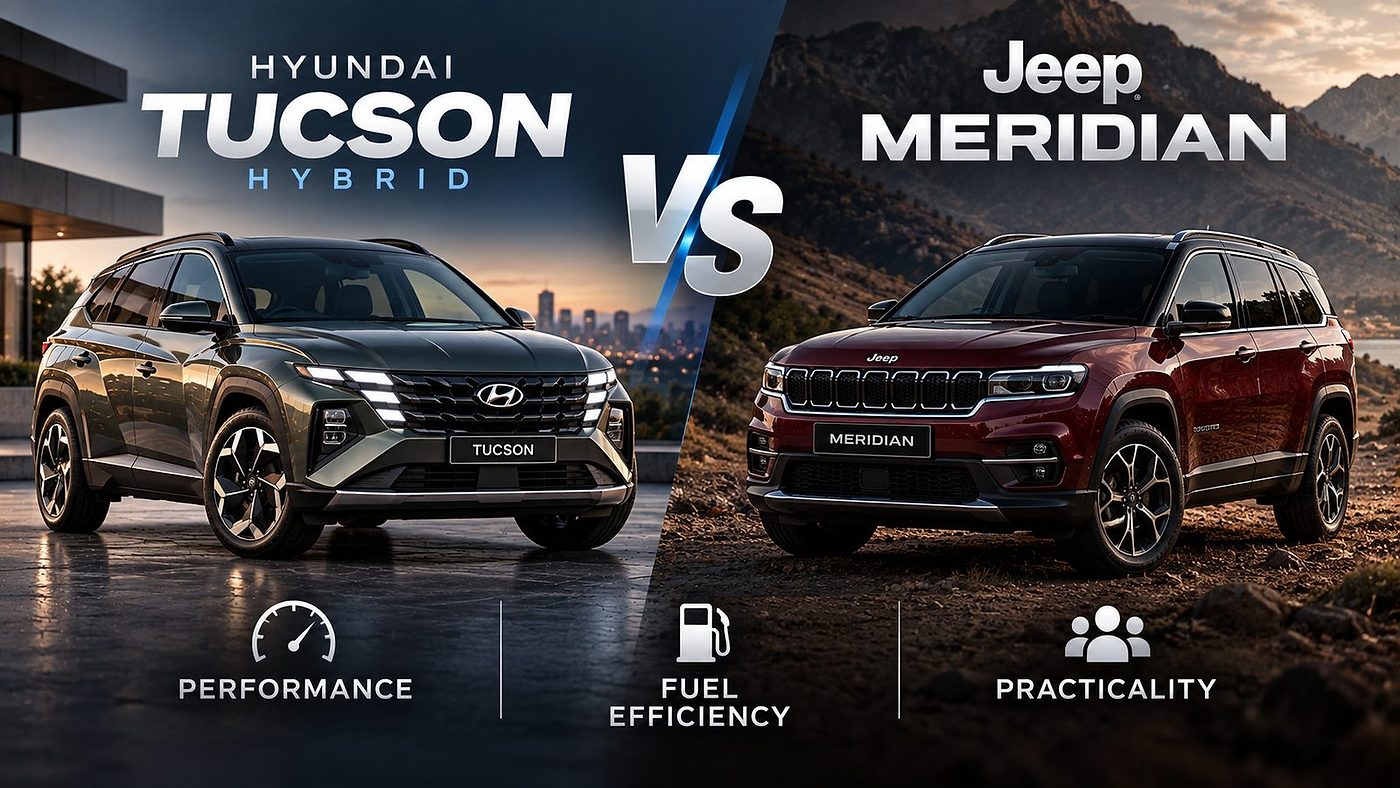
Think of the Tucson hybrid as the middle path. Against the Jeep Meridian (₹23.33–38.26 lakh), the hybrid should beat its ~14 km/l diesel on efficiency while matching power, without diesel's clatter. The EV rivals are a different game. The Mahindra XEV 9S (₹20.65–30.9 lakh), Tata Harrier EV (₹21.79–30.54 lakh) and VinFast VF 7 (₹21.9–26.8 lakh) are cheaper and cost less per km, but need home charging and planning. The Tucson hybrid asks for no charging at all. It's for buyers who want EV-like smoothness but hate charging worries. Strong hybrids also tend to hold resale better than EVs today.
Should you wait or buy now?
Our take: worth waiting if you want the latest tech and a possible hybrid. But H2 2026 is still months away, and India timing plus the hybrid itself are not confirmed. If you drive 15,000+ km a year, the hybrid's fuel savings could pay off, so waiting makes sense. If you need a premium SUV now, the current feature-rich Tucson or a Meridian diesel are solid buys today, and you skip the wait. Don't delay for a hybrid India hasn't officially promised yet. The sweet spot: if it lands, the Signature hybrid looks like the one to target.
References: Hyundai India — official website