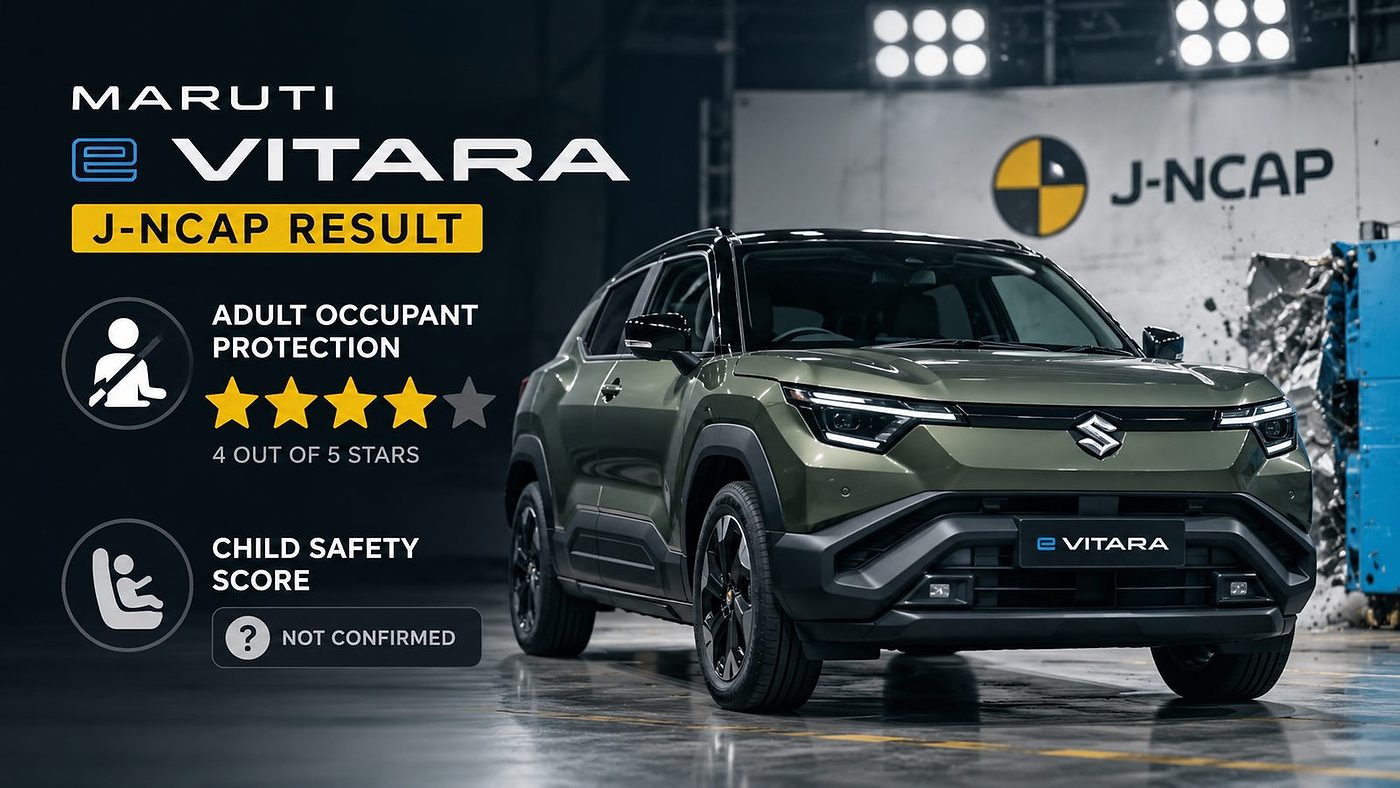
The Maruti Suzuki eVitara, the brand's first proper electric SUV, has bagged a 4-star rating for adult safety in Japan's J-NCAP crash test. It's a respectable result, but not the full 5 stars some rivals carry here. And here's the catch: this test happened in Japan, not India, so the India-spec car still needs its own Bharat NCAP check.
The J-NCAP result: 4-star adult, child score unclear
The eVitara scored 4 out of 5 stars for adult occupant protection in Japan NCAP's crash test. That covers how well the car protects grown-ups in front and side crashes. The signal we have does not confirm a separate child safety (COP) score, so we won't guess one. This is also notable as one of the first Maruti-badged models to go through a NCAP test, since the brand has long been criticised for average safety scores. A 4-star result is solid, but for a premium EV it leaves some room for doubt.
What exactly was tested, and the Japan caveat
The car tested here is the Japan-spec eVitara, not the version Maruti will sell in India. Safety kit, airbag count, and body structure can differ between markets. So we can't yet confirm which variant and how many airbags the Indian car will get. Until Maruti shares India-spec details, treat this rating as a good sign, not a promise. The real number that matters for you is the India test, which hasn't happened.
J-NCAP vs Bharat NCAP: why you can't directly compare
Japan NCAP and Bharat NCAP use different test rules and scoring. The crash speeds, the dummies, and the point systems are not the same. So a 4-star J-NCAP result does not automatically mean 4 stars in a Bharat NCAP test. Bharat NCAP scores adult safety out of 32 and child safety out of 49, with 5 stars needing roughly 27/32 for adults. The eVitara could score higher or lower once tested here, depending on the India-spec build.
Where it likely lost points
J-NCAP assesses front crash (around 64 km/h), side crash, and pole impact. A 4-star rather than 5-star result usually means the car lost some marks in one of these areas, often side or chest protection. But the detailed breakdown for the eVitara isn't in our hands yet. We won't invent where it dropped points. Once the full report is public, we'll update this with the exact split.
How it stacks up against EV rivals in India
On paper, some electric SUVs here already carry top safety scores. The Tata Nexon EV has a 5-star Bharat NCAP rating, and the MG ZS EV scored 5 stars in Global NCAP. The Hyundai Creta EV, meanwhile, hasn't been crash-tested publicly yet. So a 4-star rating, if it carries over, would put the eVitara slightly behind the safest electric SUVs in this space. That said, these are different tests, so a like-for-like comparison isn't fair until the eVitara faces Bharat NCAP. Premium EV buyers today expect 5 stars, and this is where Maruti will face real scrutiny.
Should you care? What it means before you buy
If you're eyeing the eVitara, this 4-star score is a decent early signal that Maruti is taking safety seriously with its first EV. But don't lock your decision on a Japan test. The India-spec car could get different kit, and it still needs a Bharat NCAP crash test to tell the real story. We also don't have India prices, range figures, variants, or battery details confirmed yet, so a full buyer verdict isn't possible today. Our honest advice: wait for the India launch, the India-spec safety test, and the price before you commit.
References: Maruti Suzuki India — official website · Bharat NCAP