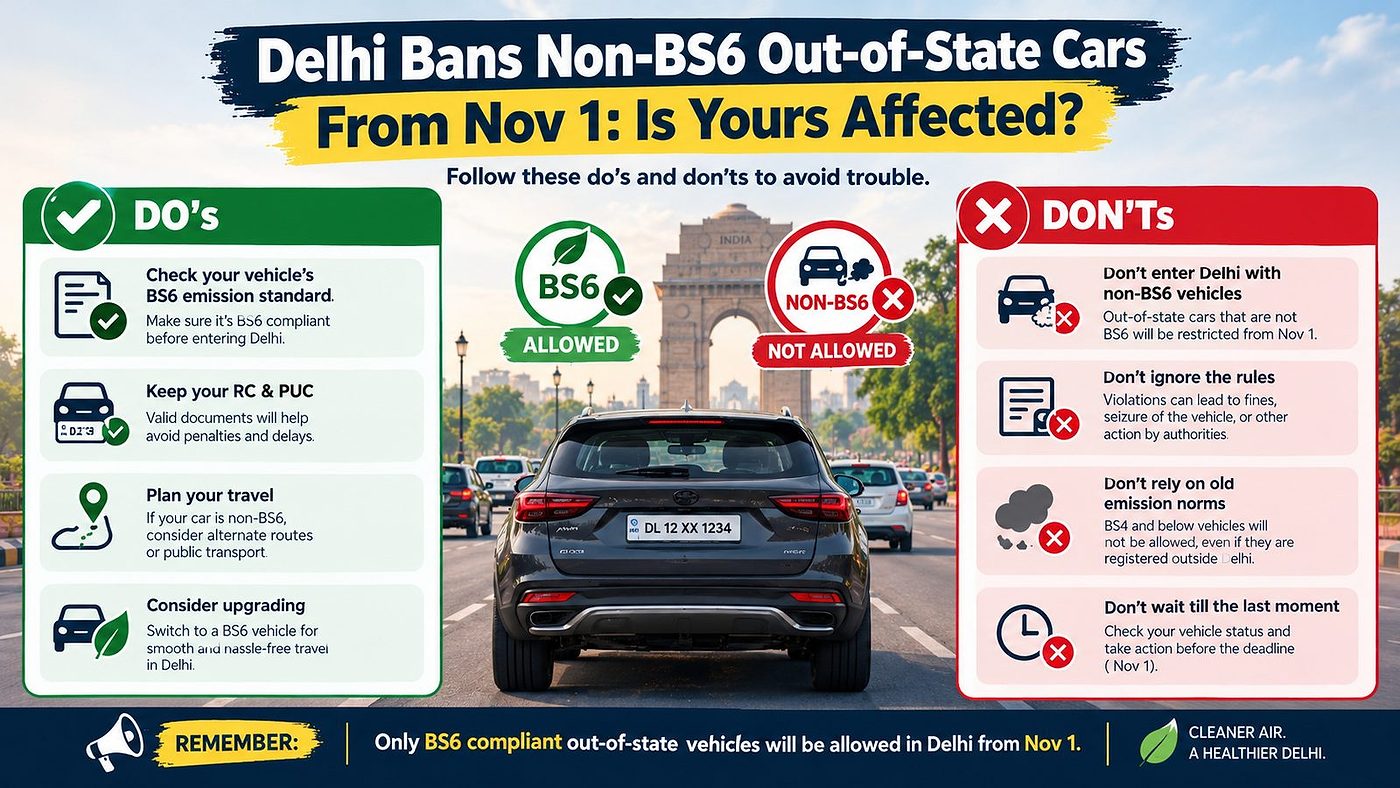
If your car is registered outside Delhi and runs on older BS4 (or earlier) emission tech, the capital is about to shut its gates on you. From November 1, 2026 to January 31, 2027, non-BS6 out-of-state vehicles cannot enter Delhi. Chief Minister Rekha Gupta announced this on October 20 as part of the winter pollution plan. Let's break down who's blocked, who's safe, and what you must do before the deadline.
What exactly is banned: the BS6 cutoff explained
The rule targets one group: vehicles registered outside Delhi that do not meet BS6 emission norms. BS6 (Bharat Stage 6, India's strictest tailpipe standard) became mandatory for all new cars sold from April 1, 2020. So any out-of-state car made and registered before that rollout is likely BS4 or older and now blocked. Cars registered inside Delhi are not covered by this entry ban. The restriction runs from November 1, 2026, to January 31, 2027, three full months through the worst of the smog season.
Who can still enter Delhi: EVs, CNG, essential services
Three groups get a clear pass. Electric vehicles are fully exempt, so a Tata Nexon EV or MG ZS EV from Gurgaon or Noida can roll in freely. CNG vehicles are also allowed, which covers a lot of out-of-town cabs and private cars running on gas. Essential services vehicles (ambulances, emergency vehicles, and government work) are exempt too. Everyone else driving a non-BS6 petrol or diesel car on out-of-state plates stays out.
The timeline and the 'No PUC, No Fuel' bite
The entry ban covers November 1 to January 31. But the wider Winter Action Plan runs longer, until February 28, 2027, so expect curbs to continue past the ban window. The sharpest new rule applies to everyone, Delhi car or not: 'No PUC, No Fuel.' Fuel stations across Delhi will refuse petrol, diesel, CNG, or LPG to any vehicle without a valid Pollution Under Control (PUC) certificate. No certificate means no fuel, full stop. Check your PUC now and renew it if it's expired, because you can be turned away at the pump.
The ₹ hit: doubled parking, staggered hours, 50% WFH
Parking gets pricier. Fees at authorized municipal parking lots will be doubled for the season. Metro (DMRC) parking lots are the exception and stay at normal rates, so park near a Metro station to save money. To cut peak-hour traffic, the government has ordered staggered office timings and 50% work-from-home across public and private offices. MCD offices will run 8:30am to 5pm; Delhi government offices 10am to 6:30pm. The clear push is to get people off private cars and onto the Metro, electric buses, and carpools.
Which popular cars are affected: a quick check
The simple test is two things: where it's registered and whether it's BS6. A Maruti Dzire, Hyundai Creta, or Toyota Innova registered in Haryana, UP, or Rajasthan and made before April 2020 is almost certainly non-BS6, so it's blocked. The same models bought new after April 2020 are BS6 and allowed in. A 2019 car is the tricky one: most 2019 registrations are BS4, so treat them as banned unless the papers say BS6. If you drive an EV or CNG car, you're fine regardless of where it's registered.
What out-of-state owners should do now
First, check your registration certificate and PUC for the emission standard; if it says BS4 or BS3, plan around the ban. If you must be in Delhi for work, use the Metro, an electric bus, or a Delhi-registered or CNG cab for those three months. Keep your PUC valid at all times, as the fuel rule hits Delhi-registered cars too. If you were already thinking of upgrading, a BS6 petrol, CNG, or EV is your long-term fix, since these winter curbs are now a yearly pattern in the NCR.