

The way India drives is changing fast. Electric cars are going mainstream, hybrids are getting popular, and now a third option is quietly gaining ground—flex fuel. And one of India's most trusted SUV makers is getting ready for it. This is where Mahindra flex fuel technology enters the picture.
Mahindra is developing a new generation of engines that can run on much higher blends of ethanol, not just regular petrol. It is a big step, and it fits perfectly with the government's push to reduce India's dependence on imported oil. But what exactly is this technology, how does it work, and what does it mean for you as a buyer? Let us break it all down in simple words.
What is flex fuel technology?
Let us start with the basics, because the term confuses many people.
A normal petrol car runs only on petrol. A flex-fuel vehicle (FFV) can run on petrol and ethanol—in almost any mix. It can use standard E20 petrol (20% ethanol, which is already sold across India) or much higher blends like E85 (85% ethanol) and even E100 (nearly pure ethanol).
The clever part is that the car does all the thinking for you. A flex-fuel engine has an ethanol sensor that reads how much ethanol is in the tank, and the engine automatically adjusts itself to run smoothly. You do not press any button or flip any switch—you just fill up and drive.
Ethanol, in case you are wondering, is made mostly from sugarcane and grain. So it is a fuel India can grow at home instead of importing crude oil from other countries. That single fact is the reason flex fuel is such a big deal for the country.
What is Mahindra flex fuel technology?
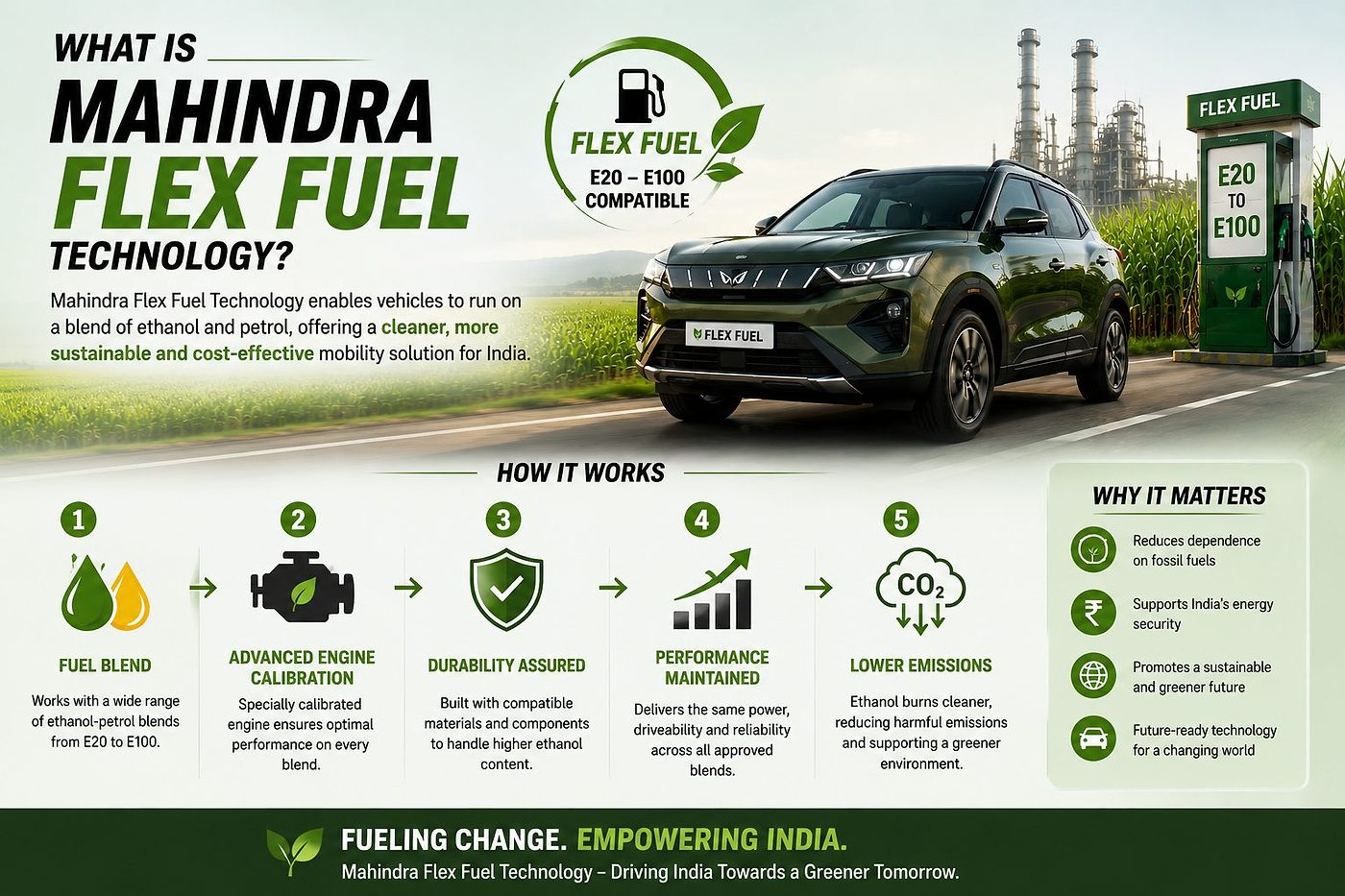
Mahindra is developing flex-fuel engines as part of its long-term plan to prepare for India's ethanol future. In simple terms, the company is reengineering its petrol engines so that future Mahindra SUVs can run on high ethanol blends—reportedly up to E85, with the eventual goal of supporting even higher blends.
The timing is deliberate. India has already met its E20 target ahead of schedule and is now aiming for a 30% ethanol blend (E30) by 2030. Beyond E30, only flex-fuel vehicles can handle the higher blends—so Mahindra wants its next generation of SUVs to be ready the moment the country makes that shift. Rather than being caught off guard by a sudden policy change, Mahindra is future-proofing its line-up in advance.
The NU_IQ platform: built for flex fuel
Here is what makes Mahindra's approach smart. The company's new NU_IQ modular platform, unveiled on Independence Day 2025, has been designed from the ground up to support multiple types of powertrains — electric, hybrid, and flex fuel — all on the same base.
This means Mahindra does not have to build a completely separate car for each fuel type. The next generation of Mahindra SUVs built on NU_IQ can be offered with flex-fuel engine options alongside petrol, diesel, hybrid, and electric versions. It is a flexible, cost-smart strategy that keeps Mahindra ready for whichever direction the market and government policy take.
How does a flex-fuel engine actually work?
Making an engine run reliably on high ethanol blends is not as simple as pouring in different fuel. Ethanol behaves differently from gasoline—it is more corrosive, and it makes cold starting harder in low temperatures. So the engine needs some real reengineering.
Here are the key parts that go into Mahindra's flex-fuel technology:
- Ethanol content sensor — reads the real-time mix of ethanol and petrol in the tank so the engine can adjust
- Upgraded fuel injectors and fuel pump — built to handle ethanol reliably
- Corrosion-resistant fuel lines — because ethanol can damage normal fuel pipes over time
- Fuel rail and injector heaters—these help the engine start smoothly in cold weather, solving one of ethanol's biggest challenges
- Recalibrated ECU—the car's brain is retuned to adjust fuel injection and spark timing based on the ethanol level
Together, these changes let the engine switch between petrol and ethanol blends automatically, without you having to do anything.
Why flex fuel matters for India
Flex fuel is not just about the car; it is about a bigger national goal. Here is why the government and automakers are backing it so strongly.
It cuts oil imports. India imports more than 85% of its crude oil. Every liter of ethanol used in place of petrol reduces that dependence. Official estimates show that ethanol blending between 2014-15 and mid-2025 saved over ₹1.44 lakh crore in foreign exchange.
It is cleaner. Sugarcane-based ethanol produces around 65% lower lifecycle greenhouse gas emissions than petrol. That is a meaningful cut in pollution.
It helps farmers. Since ethanol is made from crops, higher demand means more income for rural India. The government estimates flex fuel adoption could generate thousands of crores in additional farmer income.
For a country that wants energy security, cleaner air, and a stronger rural economy all at once, flex fuel ticks several boxes.
The honest challenges: what you should know
Now, let me be straight with you, because no technology is perfect.
Fewer pumps for high blends. India has done very well with E20, which is available almost everywhere. But pure ethanol blends like E85 and E100 are sold at only a handful of stations right now, mostly in Delhi-NCR and the Mumbai-Pune-Nagpur belt. The government plans around 500 ethanol stations by December 2026 and nearly 5,000 by the end of 2027 — but that network is still being built.
Lower mileage on high ethanol. Ethanol has less energy than petrol for the same amount. So on high blends like E85, you may get fewer kilometers per liter. The savings only work out if ethanol is priced low enough to make up for that.
A small price premium. Flex-fuel components add cost. Mahindra itself has indicated a rough 5-7% price premium over standard models. This is expected to shrink as the technology becomes more common.
The good news? A flex-fuel car also runs perfectly on the regular E20 petrol available everywhere, so you are never stuck. You simply unlock the full ethanol benefit once the pump network grows.
Mahindra flex fuel vs the rest of the industry
Mahindra is not alone in this race, and that is a good sign, because it means flex fuel has real industry momentum behind it.
At recent auto shows, Maruti Suzuki showcased the Wagon R Flex Fuel (now India's first mass-market flex-fuel car), Tata displayed an E85-compatible Punch, Hyundai revealed a Creta that runs on E0 to E100, and Toyota went a step further with a flex-fuel Innova Hycross that pairs ethanol with strong hybrid technology. In fact, around a dozen automakers are now preparing flex-fuel models under India's new E100 framework.
Mahindra's edge is its focus on SUVs and its flexible NU_IQ platform, which lets it add flex fuel across a wide range of future models. As India's SUV leader, Mahindra bringing flex fuel to its popular line-up could push the technology into the mainstream faster.
Should you be excited about Mahindra flex fuel technology?
Here is my honest take.
Mahindra flex fuel technology is a genuinely smart, forward-looking move. It prepares the brand — and its buyers — for a cleaner, more energy-secure future, without forcing everyone to jump straight to electric. For India, it is exactly the kind of practical, home-grown solution that makes sense.
That said, if you are buying a car today, the full benefits of flex fuel are still a year or two away, simply because the high-blend pump network is not ready yet. So do not rush a purchase just for flex-fuel capability. But as a sign of where Mahindra and India are heading, this technology is very promising — and worth keeping an eye on when the next generation of Mahindra SUVs arrives.
Frequently Asked Questions
What is Mahindra flex fuel technology? It is Mahindra's development of engines that can run on high ethanol blends, reportedly up to E85, in addition to regular petrol. These engines automatically adjust to the ethanol level in the fuel, and will feature in future Mahindra SUVs built on the NU_IQ platform.
What is a flex-fuel vehicle? A flex-fuel vehicle can run on both petrol and ethanol in almost any mix — from E20 (standard pump petrol) up to E85 or E100 (high ethanol blends). A sensor reads the fuel mix and the engine adjusts automatically.
Which Mahindra cars will get flex fuel engines? Mahindra has not confirmed specific models yet. The flex-fuel engines are expected to appear in its next-generation SUVs built on the new NU_IQ modular platform.
Is flex fuel better than electric? They serve different needs. Flex fuel is a cleaner option that still uses a familiar petrol-style engine and does not need charging, while EVs offer zero tailpipe emissions but need charging infrastructure. Flex fuel works well as a bridge for buyers not ready to go fully electric.
Does flex fuel give lower mileage? On high ethanol blends like E85, mileage can be lower because ethanol has less energy than petrol. The savings depend on ethanol being cheaper at the pump. On regular E20 petrol, the difference is minimal.
Where can I find high ethanol fuel like E85 in India? High blends are currently available at only a limited number of stations, mainly in Delhi-NCR and the Mumbai-Pune-Nagpur region. The government plans around 500 stations by end of 2026 and nearly 5,000 by the end of 2027.