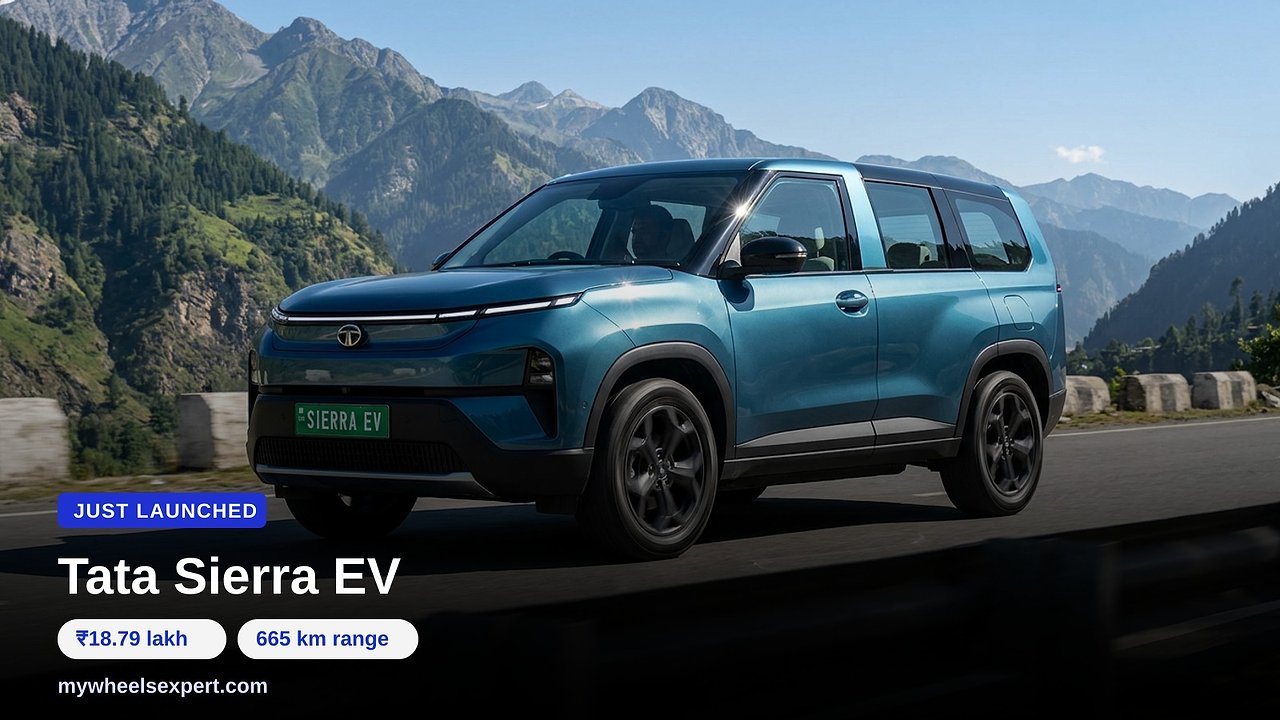
The Tata Sierra is one of those names that resonates with anyone who grew up around Indian roads in the 1990s. The original was a three-door lifestyle SUV with a wrap-around rear glasshouse unlike anything else on the road when it was launched in 1991. It showed a generation that an SUV could be aspirational, not just utilitarian. Today, Tata has revived that name in the form it always seemed destined to take: a fully electric, truly premium SUV.
The Sierra EV was launched in India on 30 June 2026, priced between ₹18.79 lakh and ₹25.99 lakh (ex-showroom). It slots between the Curvv EV and Harrier EV in Tata's range, and is the clearest attempt yet by the brand to prove it can build an electric car you want, not just one you can afford. To be clear, today's launch is the electric Sierra only; the petrol and diesel Sierra is a separate car that went on sale back in November 2025.
Price and variants
The Sierra EV is available in five trim names across eight configurations, depending on battery size and drivetrain:
- Pure — 63 kWh, RWD — ₹18.79 lakh
- Pure S — 63 kWh, RWD — ₹19.99 lakh
- Adventure — 63 kWh, RWD — ₹20.99 lakh
- Adventure — 75 kWh, RWD — ₹22.19 lakh
- Empowered — 63 kWh, RWD — ₹22.79 lakh
- Empowered — 75 kWh, RWD — ₹23.79 lakh
- Empowered A — 75 kWh, RWD — ₹24.79 lakh
- Empowered A — 75 kWh, AWD — ₹25.99 lakh
Bookings opened on launch day, with deliveries commencing 15 July 2026. A 7.2 kW home charger with installation is available for about ₹49,000.
Design: the Sierra look, revisited
Tata's designers knew what made the original special, and the defining element is still here. The large wrap-around rear quarter-glass, the so-called Alpine glasshouse, has been reinterpreted for a modern five-door body with gloss-black pillars giving the roof a floating effect. Up front, a full-width connected LED light bar stretches across a body-coloured, closed-off grille, and a matching bar runs across the tailgate. It sits on 19-inch aero-optimised alloy wheels.
It is a big car, measuring 4,340 mm long, 1,841 mm wide and 1,750 mm tall, with a 2,730 mm wheelbase and 205 mm of ground clearance. The boot holds 622 litres with an additional 55-litre front storage compartment on rear-wheel-drive models. Buyers get seven colours, including a new electric-only shade called Rishikesh Rapids.
Inside: three screens and plenty of tech
The top variants get a first-of-its-kind triple-screen dashboard, with a 10.25-inch driver display, a 12.3-inch central touchscreen and a 12.3-inch screen for the front passenger; lower trims get a dual-screen layout. Connectivity includes wireless Android Auto and Apple CarPlay, an EV route planner, Tata's iRA connected-car package with 5G and over-the-air updates, and a 12-speaker JBL system with Dolby Atmos on the higher trims. There is a panoramic sunroof, ventilated and powered front seats, dual-zone climate control and a gesture-controlled powered tailgate.
Battery, range and charging
The Sierra EV uses lithium iron phosphate batteries in two sizes. The 63 kWh pack has a claimed range of about 565 km, while the 75 kWh pack is rated at up to 665 km, one of the best figures in the segment; expect real-world range closer to 460 to 500 km on the bigger battery. Interestingly, the 63 kWh rear-wheel-drive model makes the most power of the single-motor cars at 235 bhp, while the 75 kWh version is tuned for range at 206 bhp. The dual-motor all-wheel-drive Empowered A combines both motors for about 344 bhp and 504 Nm, enough for 0 to 100 km/h in 5.8 seconds. On a 120 kW DC fast charger, the battery goes from 20 to 80 percent in about 26 minutes.
Safety
All Sierra EVs come with six airbags and Level 2 ADAS features such as adaptive cruise control, automatic emergency braking, lane-keep assist and blind-spot monitoring, plus a 540-degree camera and disc brakes on all four wheels. On crash ratings, it pays to be precise: the petrol and diesel Sierra has a 5-star Bharat NCAP rating, but the electric version had not been crash-tested at the time of launch, so its official star rating is still awaited. Tata offers a lifetime battery warranty, valid for 15 years for the first owner.
Electric or petrol-diesel Sierra?
Because Tata sells both a combustion and an electric Sierra, the more useful question for many buyers is which one to pick. On our data, the petrol and diesel Sierra spans ₹11.49 lakh to ₹21.29 lakh, while the Sierra EV runs from ₹18.79 lakh to ₹25.99 lakh. So the electric car starts roughly ₹7 lakh higher, but the two ranges overlap in the middle.
Buy the petrol or diesel Sierra if you want a lower entry price, cannot charge at home, do frequent long highway trips or drive in smaller towns where chargers are sparse, or want a proven 5-star safety rating today. Buy the Sierra EV if you can charge at home, mostly drive in and around the city, want the lowest running cost per kilometre, want the strongest performance and the newest cabin tech, and want lower emissions.
Which one should you buy?
For most buyers, the 63 kWh Pure S or Adventure is the strongest option, with plenty of range and equipment for under about ₹21 lakh. If you drive long distances regularly, the 75 kWh Empowered is the one to have. The all-wheel-drive Empowered A is for those who want the performance and light off-road ability, and are willing to pay close to ₹26 lakh.
The bottom line
The Sierra EV is more than a nostalgia piece. With the range, features and design to back it up, Tata is making a serious play for the premium electric SUV space. Cabin quality and real-world range will come under scrutiny, but as a statement of intent, it is hard to ignore. For a brand that built its EV business on affordability, the Sierra EV is the moment it reaches for aspiration.